Home · About
01 — The house · established 1986
Two harvests a year.
One standard, always.
A Danish–Somali company built to make the oldest aromatic trade on earth behave like a modern raw-material supply chain.
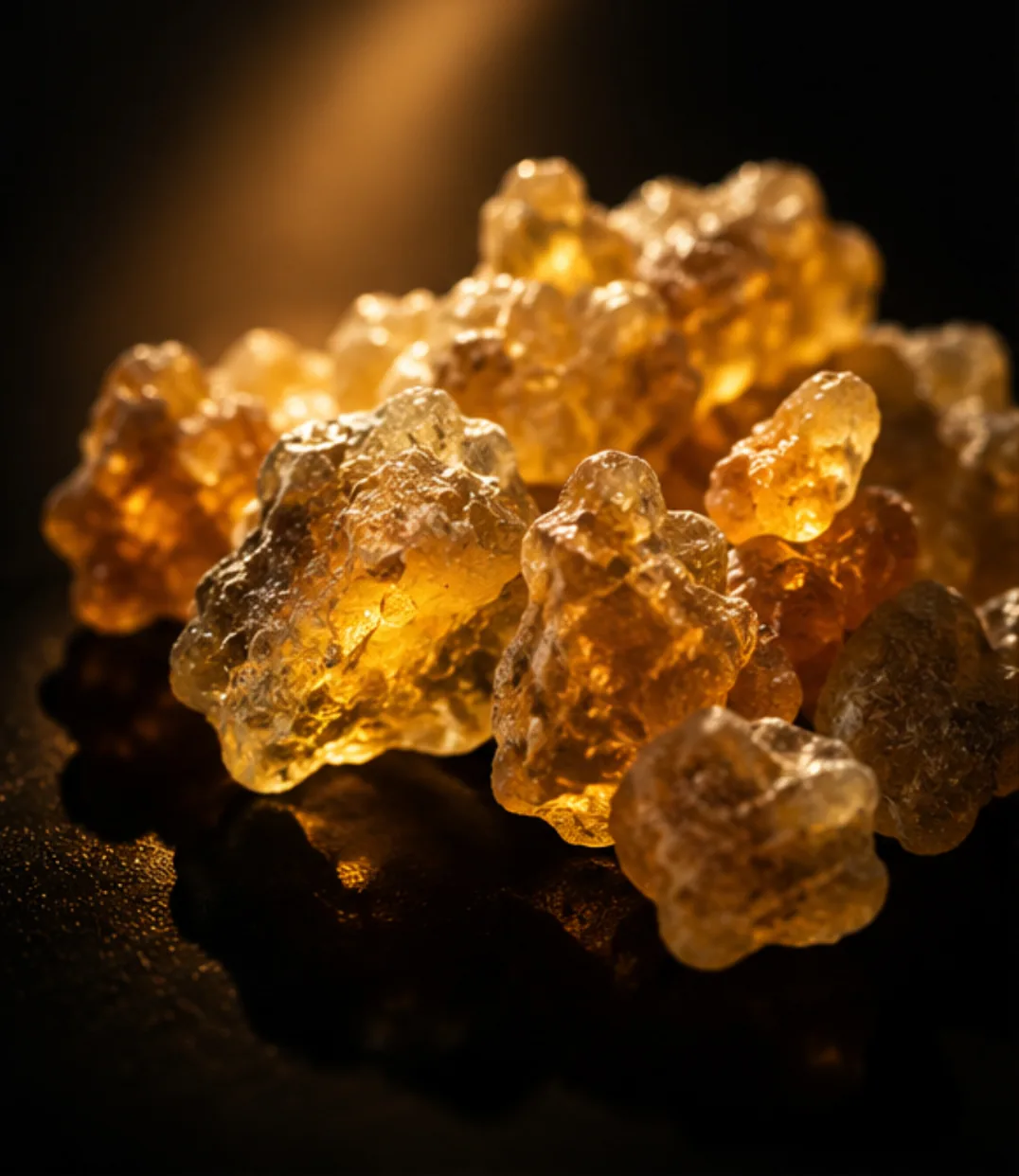
For four thousand years, frankincense and myrrh have left the escarpments of northern Somalia for the temples, apothecaries and perfume houses of the world. The material has never been the problem. What has been missing is the ordinary commercial furniture that every other raw material takes for granted: a grade a European perfumer can specify, a document a customs broker can rely on, and a chain that can be followed backwards from the drum to the tree.
Horn Resins was built into that gap. Our harvesting teams work the Cal Madow and Golis ranges. Consolidation, cleaning and grading happen at our facility in Bosaso. Every shipment is managed from our European office in Aarhus, Denmark — one point of contact, in your time zone, under EU commercial terms and EU banking.
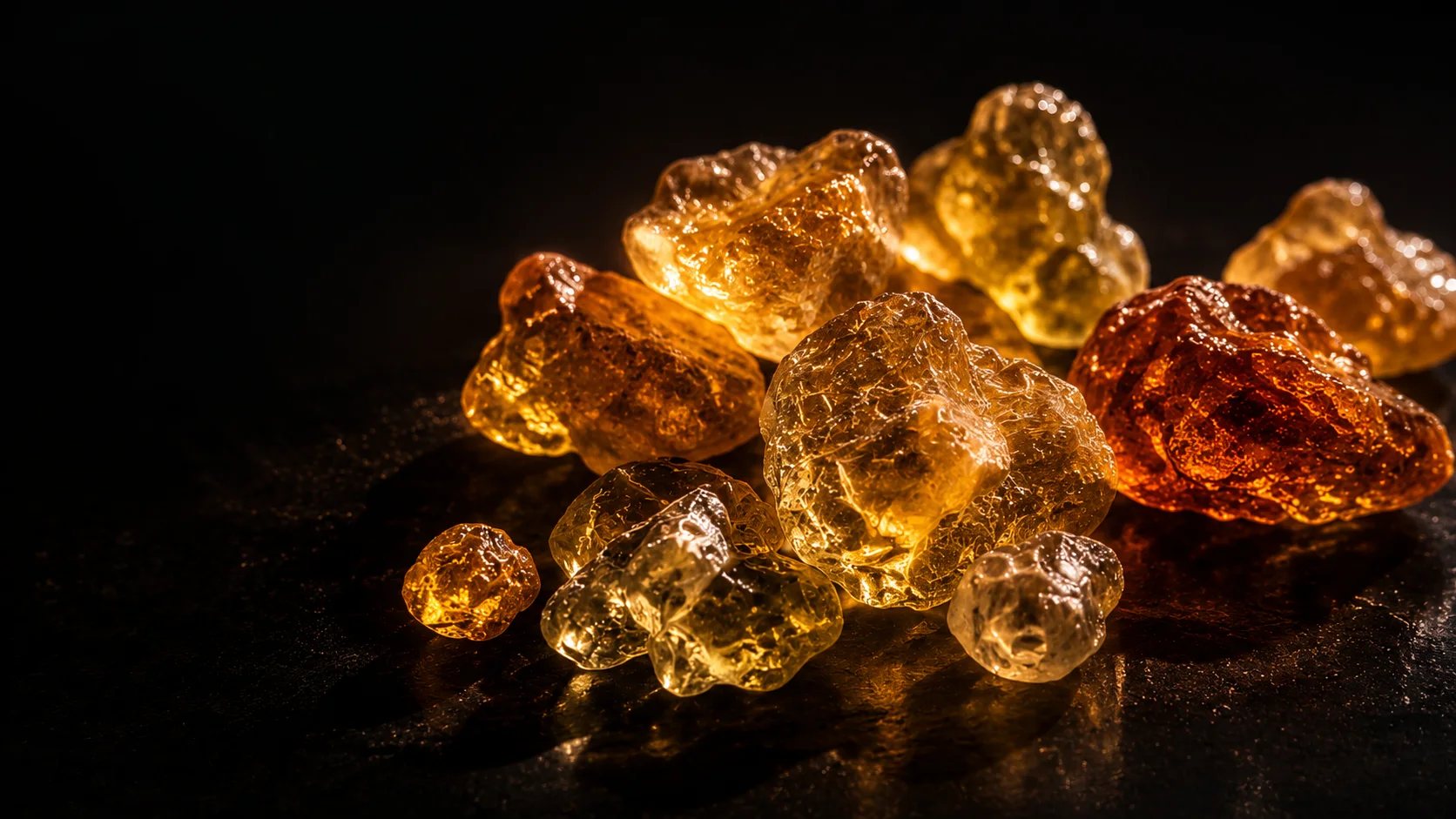
Nothing leaves without a written grade specification. Every lot is hand-sorted, sampled and photographed before it ships, so that what a buyer approves is what a buyer receives. Where a contract requires it, GC/MS, microbiology and heavy-metal analysis are arranged through our partner laboratory inside the EU.
It is a deliberately unglamorous way to sell something ancient. It is also the only way to sell it to Roeper, to a fragrance house, or to a pharmacopoeia buyer twice.
Buying at origin, graded at origin, is the only way to secure the top of each harvest.
Mission
Make Somali resin as dependable to buy as any European raw material
— without taking the origin out of the product. Standardisation should discipline the paperwork, not flatten the material.
Vision
Europe's reference supplier of Boswellia and Commiphora by 2030
Judged on the boring things: repeatable grades, documents that arrive before the container does, and a telephone that is answered.
02 — The recent record
The modern export operation
Consolidated direct shipments from the Bari highlands begin under the current export structure.
Grading protocol formalised. Warehouse established in Bosaso.
European office opens in Aarhus, Denmark.
GC/MS partner laboratory contracted inside the EU.
120+ harvesting families under seasonal contract.
Catalogue No. 1. Export capacity 200 t per year.
Scroll the timeline sideways.
03 — Operations
Four places, one lot number
Harvesting teams
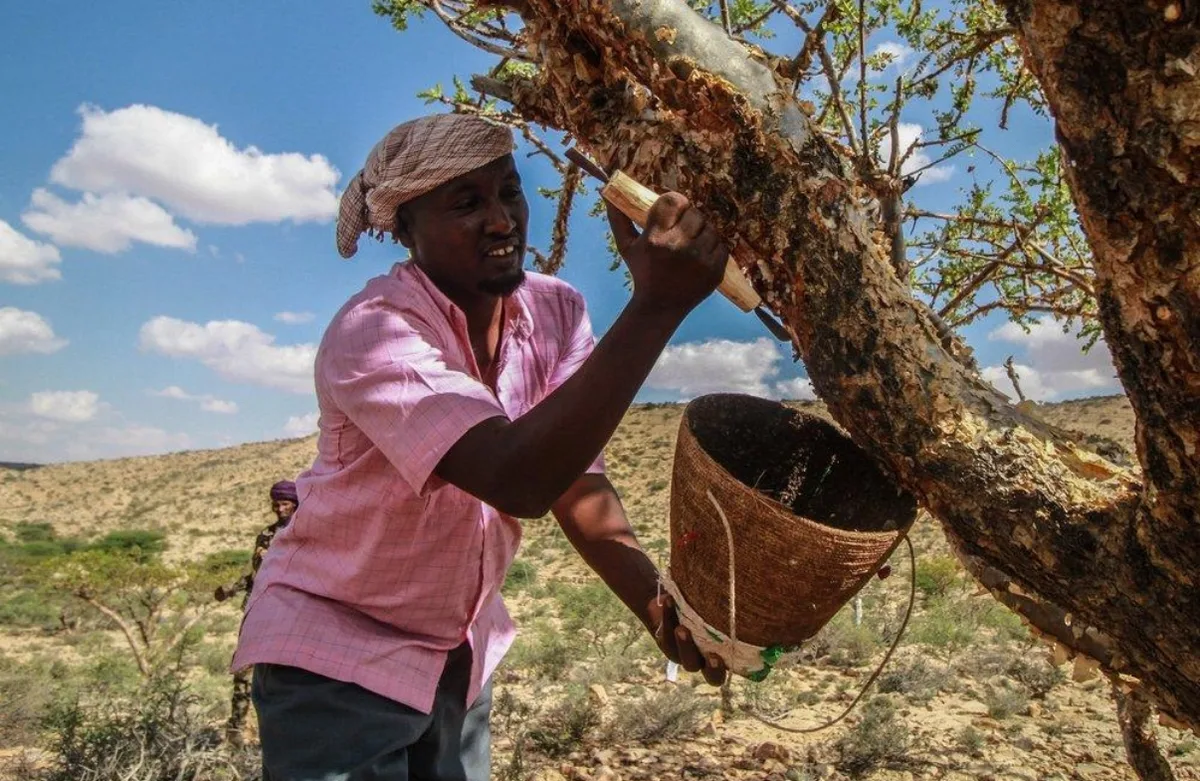
Mature wild Boswellia and Commiphora stands, mapped and rested between seasons. No tree is tapped more than twice a year, and bark is lifted with the traditional mingaaf blade rather than stripped, so the tree closes within the season.
Consolidation & grading
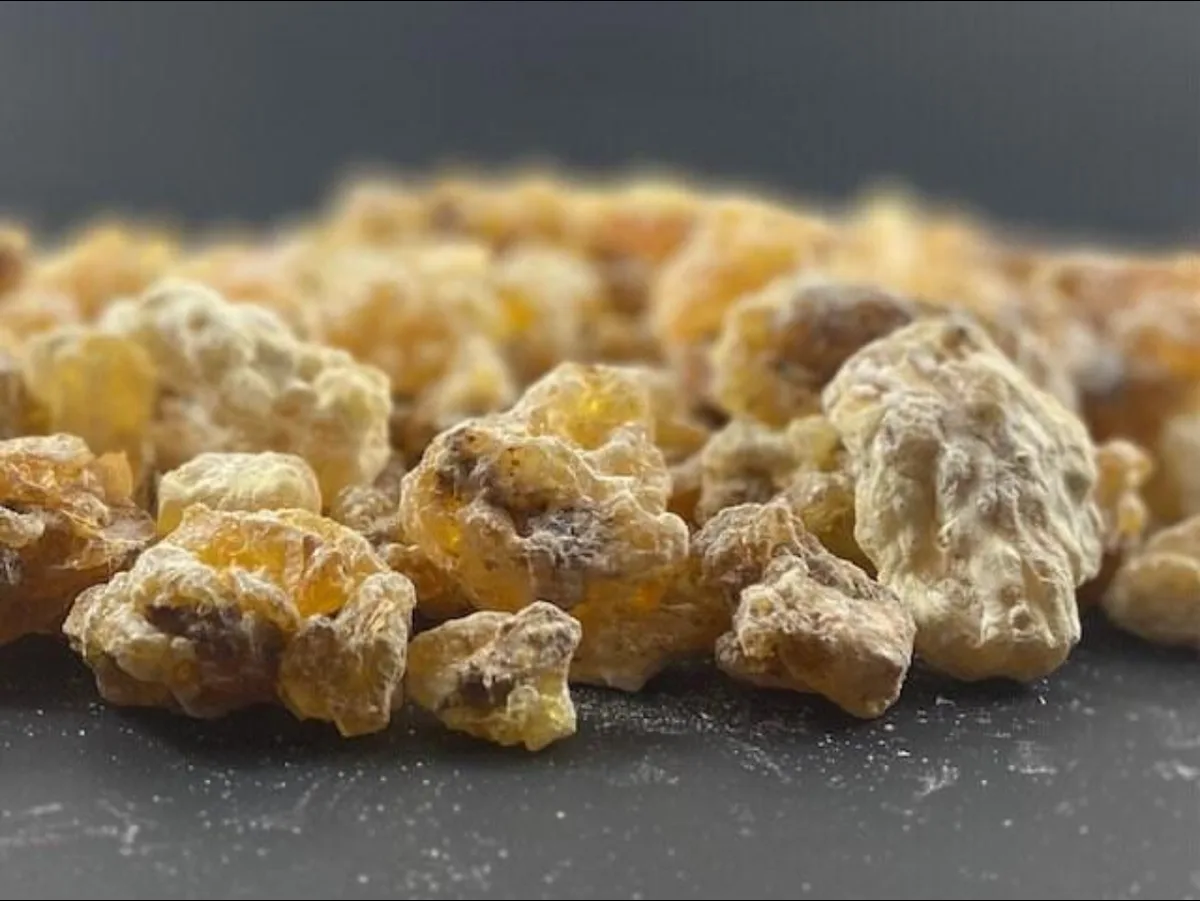
Lots arrive from several collection areas and are cleaned, hand-sorted by size, colour and clarity, and graded against a written standard. Each lot is sampled and photographed before it is offered — the photographs are what a buyer approves against.
Packing & export
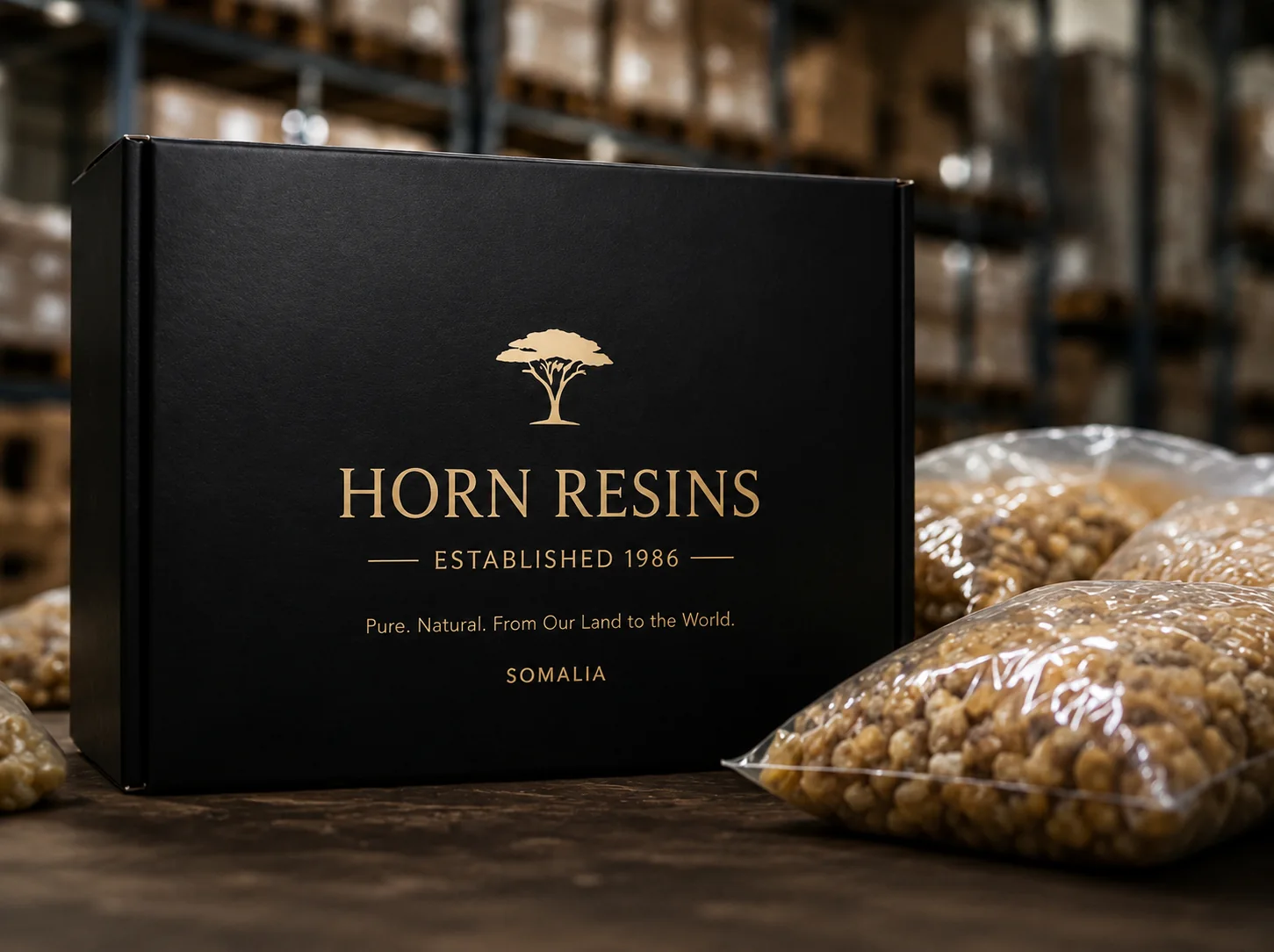
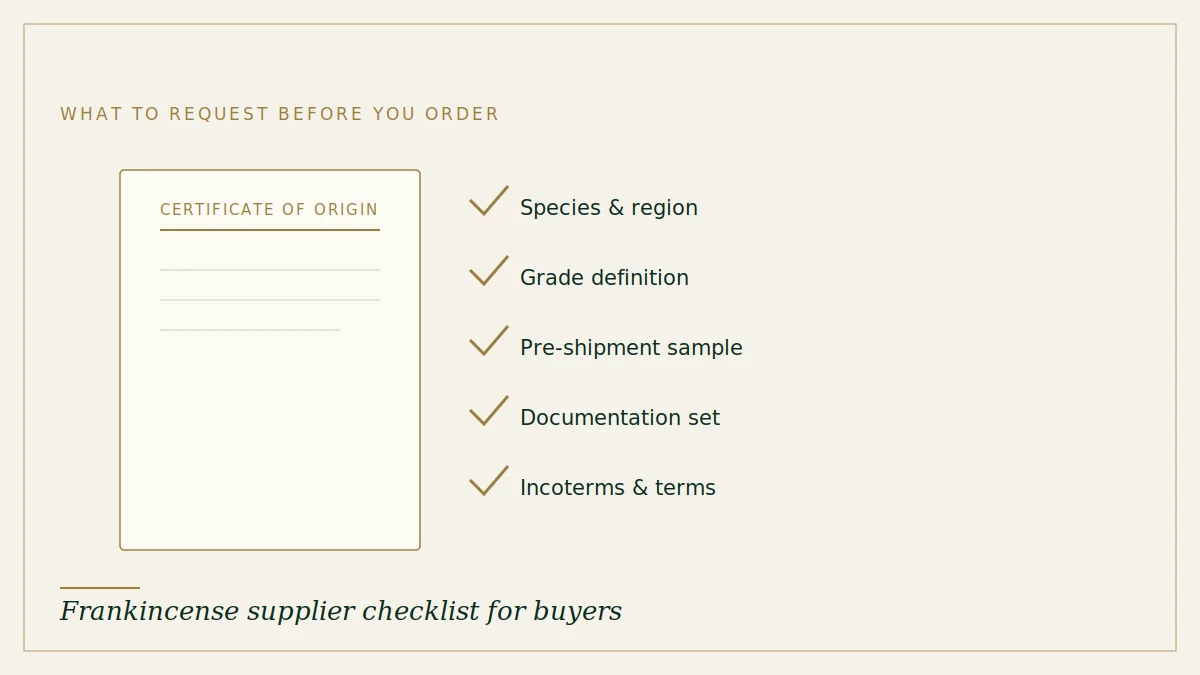
Food-grade PE liner in woven PP or jute, heat-sealed, lot-labelled and palletised. Shipped FOB Bosaso or Berbera, or CIF/DAP into Europe, with phytosanitary certificate, certificate of origin and the full lot dossier.
The European desk
Quotation, contract, samples and documents are handled from Denmark: EU time zone, EU banking, EU commercial terms. If a shipment needs a certificate re-issued or a laboratory result chased, that happens here rather than three time zones away.
04 — Origin
Somalia — the frankincense coast
Bari, Sanaag and Sool — the limestone escarpments of Cal Madow and the Golis range, 700–2,100 m above sea level.
Wild Boswellia frereana and B. carterii stands, many trees over a century old, growing from bare rock without irrigation.
Semi-arid monsoon. Two dry seasons give two tapping windows; hot dry winds cure the resin on the tree.
Bosaso and Berbera — weekly feeder services to Salalah and Jebel Ali, onward to all main EU ports.
Typically 28–35 days to Rotterdam or Hamburg, with full documentation ahead of arrival.
05 — Where we are
Two offices, one answer
Taleex Street, Hodan, Mogadishu
Warehouse and grading facility, Bosaso, Bari
+252 61 557 4229
Karen Blixens Boulevard 7, 8220 Aarhus
Quotation, contracts, samples and documents
+45 22 50 46 21
Start with a sample, not a brochure.
Tell us the species, the grade and the destination port. We will come back with what is actually available from this harvest.